


An extended goatee or tapered box beard is a good starting point for a round face with a soft jawline. Both keep the cheeks lean and add length below the chin. A custom beard trim squares off the base so the sides of your face look slimmer.
Our grooming blog has more advice on choosing and maintaining a beard shape.
Hair density matters here, along with gaps in cheek growth and whether the hair on your neck grows outward or upward.
Cutting too close to the jawbone or leaving thick cheeks can make your face look rounder. We build definition by setting the neckline lower and shaping angles that give the jaw a sharper outline. Our guide to men's style cuts and quick fades covers the haircut side separately.
What's Inside This Guide
- How Facial Hair Geometry Corrects Jawline Imbalances
- Picking the Primary Beard Architecture for Soft Features
- Matching Beard Density to Your Everyday Routine
- Blending Sideburn Transitions and Necklines Seamlessly
- Professional Sculpting Steps for Crisp Jaw Boundaries
- Investing in Regular Beard Maintenance and Lineups
- Common Questions About Styling Round Faces and Soft Jaws
- Plan Your Tailored Grooming Session in Westlake Village
How Facial Hair Geometry Corrects Jawline Imbalances
A soft jawline has less definition at the lower corner of the jaw, where it blends into the neck. The wrong beard shape adds width to the cheeks and makes full features more noticeable. Left to grow without shaping, cheek hair can make the face look more oval or round.
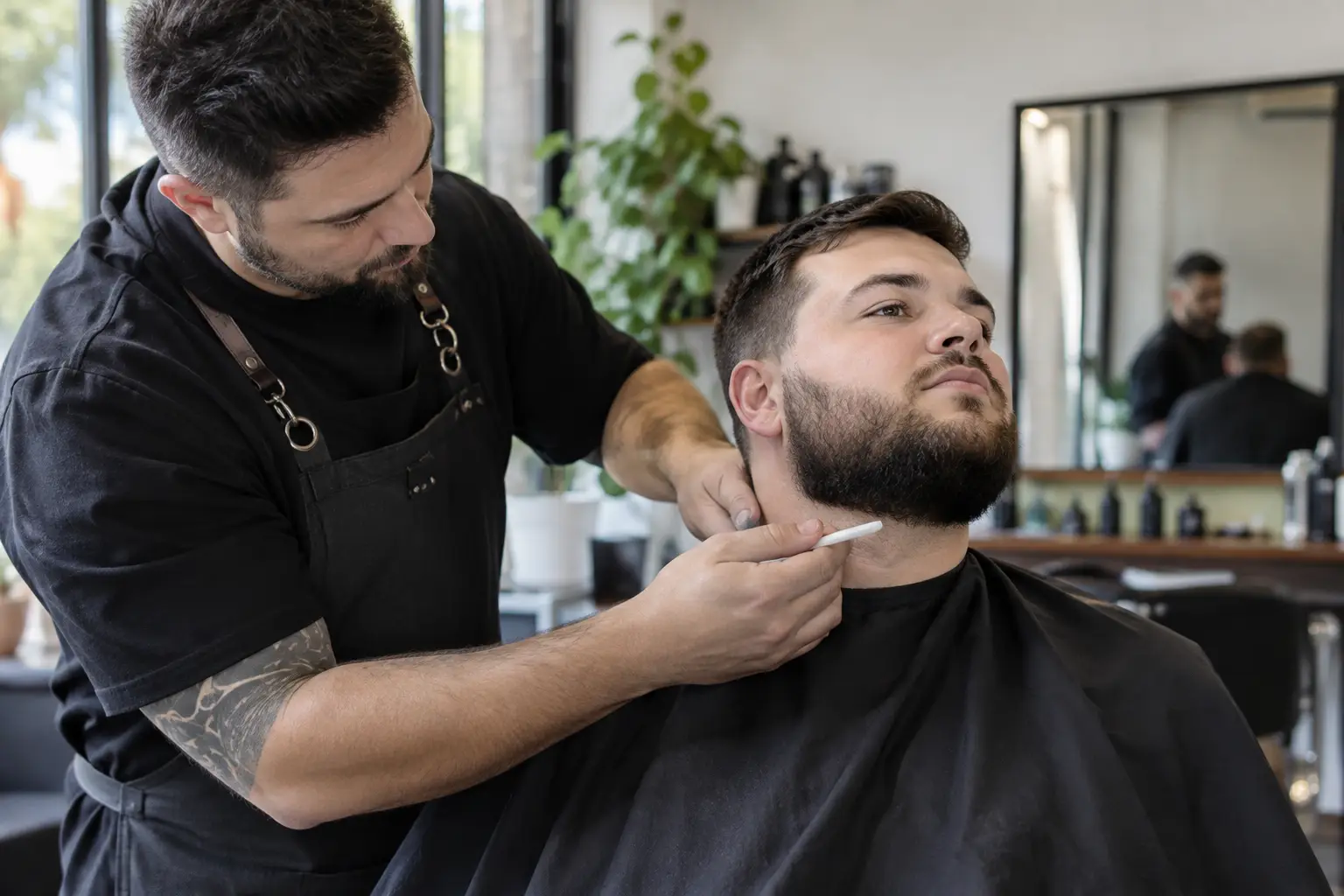
One misplaced line can undo the shape. Men often shave along the jawbone to define it, but this can suggest a double chin during speech or when looking down. Read about common beard trimming mistakes to see why keeping some weight under the chin gives the beard depth.
Barber's rule: Keep the neckline off the jawbone, about two finger-widths above the Adam's apple. That leaves a shelf of hair to give the jaw a firmer outline.
Picking the Primary Beard Architecture for Soft Features
Beard shape changes the proportions you see from the front and the side. For softer features, we aim to add length and clear angles. With clipper-over-comb work, the barber guides clippers across a comb to taper the cheeks toward stubble while keeping the chin dense.
Video: Bombay Shaving Company demonstrates six beard styles for round faces.
Primary Beard Shapes for Round Face Profiles
| Option | Recommended Starting Point | What to Watch |
|---|---|---|
| Tapered box beard | Close-trimmed cheeks with a squared base under the chin | Rounding the bottom corners takes definition away from the jaw |
| Extended goatee | Dense chin hair joined to light stubble along the jaw | Blend the mustache so the change in length is not abrupt |
| Van Dyke style | Pointed chin beard with a separate, neatly trimmed mustache | Needs precise lines, and patchy chin growth leaves skin showing |
| Heavy stubble with low cheeks | Taper sideburns to 3mm, leaving 5mm at the chin | Uneven necklines can draw attention to skin imperfections |
The tapered box beard gives a soft jawline the clearest change in shape. Its flat base draws the eye down toward the chin. Keeping that shelf clean makes the cheeks look slimmer without relying on rounded edges.
Matching Beard Density to Your Everyday Routine
Texture affects how well your beard holds its shape after you leave the chair. Coarse curls need careful moisture control to keep the sides from flaring out. For men who wear a suit to work in Westlake Village, frizzy cheek growth can look out of place in meetings.
Our beard trim and treatment combines deep hydration with shaping, softening wiry hair before we set the lines.
| Situation or Style | Recommended Choice | Avoid |
|---|---|---|
| Office executive | Close taper leading into a 1-inch squared chin | Fluffy side growth that spreads outward |
| Active / outdoor | Heavy stubble graduating from 3mm to 6mm | Long chin hair that hangs loose and collects sweat |
| Thin or patchy cheeks | A separate chin strap or disconnected goatee | Wide cheek lines with sparse, see-through growth |
| Coarse / wiry hair | A scissor-shaped box beard with razor-cleaned edges | Blunt clipper cuts that cause split ends |
Practical check: Check your profile in a mirror while standing naturally. If the beard's bottom edge slopes up toward your ears, it is too short and makes the neck look thicker.
Blending Sideburn Transitions and Necklines Seamlessly
Your haircut and beard need to work together. Bushy sideburns next to a tight fade create a sudden bulge that widens the face at ear level. A gradual blend from the temples down to the jaw keeps the profile slim.
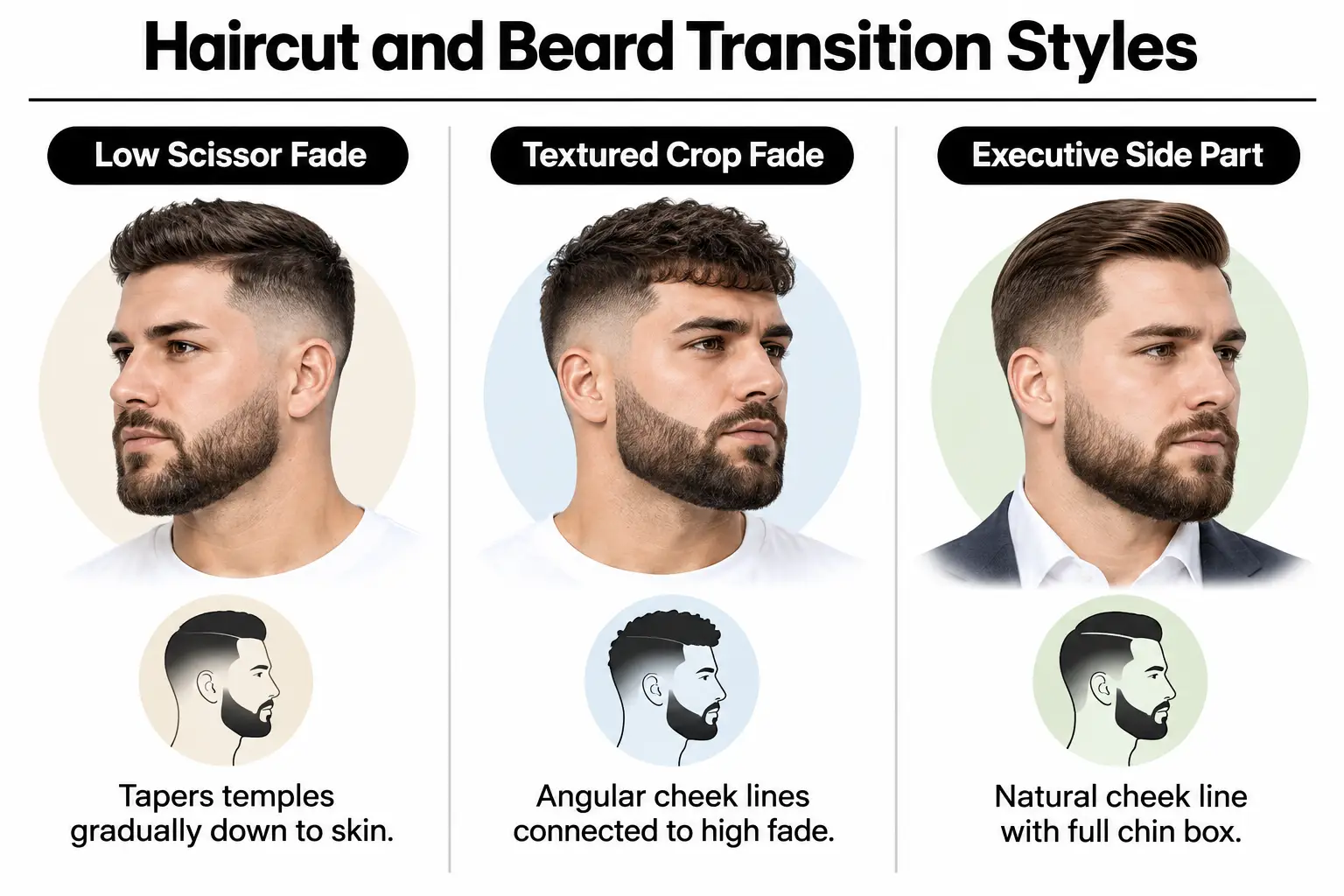
Ask your stylist to plan your beard shaping alongside your haircut, so the edges connect properly around the ears. Styles that lose their shape after washing often need a closer look at growth patterns. Our guide explains why a haircut may only look good on the first day and how the cut should work with your hair.
| Starting Point | Pairing Direction | What to Sample or Test | Intended Effect |
|---|---|---|---|
| Low scissor fade haircut | Sideburns tapered gradually down to bare skin | Check sideburn depth with a comb against the fingers | Makes wide temples look flatter |
| Textured crop on top | Straight, angled cheek line with a square chin | Check a chalk line from the ear to the mouth | Adds sharp lines against round cheeks |
| Classic executive side part | Medium-density box beard with a soft, natural cheek line | Test the angled scissor trim around the beard's outer edge | Gives a mature look with a sense of authority |
| Receding front hairline | A prominent chin as the focal point | Check how density changes beneath the center of the chin | Draws attention from the forehead toward the jaw |
Professional Sculpting Steps for Crisp Jaw Boundaries
Before cutting, we need to know where each line will sit. Blunt clippers used at home can cut into the weight that supports the beard's shape, taking off weeks of growth in one pass.
- Map the neck baseline: Find the crease just above the Adam's apple. Set a curved line that rises behind the corner of the jaw, near the earlobes.
- De-bulk the cheeks: Use clippers with a light guard, or scissors over a comb, to flatten stray upper-cheek hair. Follow the cheekbone's natural downward slope.
- Establish the chin shelf: Comb the chin hair straight down, then hold scissors horizontally to trim a flat base. Keep that edge at a right angle to the neck.
- Bevel the lower corners: Use scissors to soften the far corners beneath the back of the jaw. This lets the beard meet the neck without a blocky edge.
- Shave the negative space: Remove stray stubble above the cheek line and below the neckline. A very sharp blade leaves a clean strip of skin around those borders.
Grooming check: Trim only when the beard is fully dry. Wet hair stretches, then shrinks unevenly as it dries, which can leave hollows in an otherwise even cut.
Investing in Regular Beard Maintenance and Lineups
Hair grows roughly half an inch a month, so cheek fades and a defined chin shelf lose their edge within two to three weeks. Regular upkeep keeps the shape from widening again. The American Academy of Dermatology's grooming guidelines can help you protect the skin's barrier and avoid ingrown hairs while shaving.
| Budget Level | What to Prioritise | What to Question |
|---|---|---|
| Essential tier ($) | A clean neckline and cheeks trimmed with one guard length | Rushed appointments that skip hot towel prep on sensitive skin |
| Tailored studio tier ($$) | A scissor-shaped chin box with faded sideburns and blade-defined edges | A standard shape chosen without checking your bone structure |
| Executive spa tier ($$$) | Full beard shaping with deep steam treatment and conditioning oil | Too many chemical treatments that strip the hair's natural oils |
Booking a custom trim every 3 weeks helps you avoid taking too much off at home. One bad shave can remove the chin shape you have built, and regrowing that length can take months.
Common Questions About Styling Round Faces and Soft Jaws
Can a beard trim really make a round face look slimmer?
Yes, closely trimmed sides and dense length beneath the chin make the face look longer and leaner. The extra length balances full cheeks. Shaping those edges gives the appearance of a sharper jaw, even where the natural bone line is soft.
Where should my beard neckline sit if I have a double chin?
Set the neckline about one to two finger-widths above the Adam's apple, curving it neatly beneath the jaw. Going higher leaves neck tissue spilling over the hairline. That draws the eye to the soft skin under the chin rather than the beard's outline.
What is a mens haircut to slim round face profiles when paired with a beard?
Consider a classic pompadour or a textured crop with faded sides. Both pair well with a beard on a round face. Volume on top adds height, while tapered temples and beard sides take away width, making the face appear longer.
Who is the best stylist to shape a beard to fit my face?
Look for someone who checks your jaw angle and studies how the cheek hair grows before reaching for clippers. Cowlicks need attention too. The right stylist uses scissors as well as clippers to shape lines around your face, rather than applying the same outline to everyone.
How often should I get an expert beard trim and shaping near me?
Book professional shaping every two to three weeks to maintain the angles and cheek taper. After more than a month, hair at the sideburns and cheeks starts to flare outward. That extra width brings back the round outline the trim was meant to reduce.
Plan Your Tailored Grooming Session in Westlake Village
At North Ranch Styling Lounge in Westlake Village, California, we check your growth patterns and head shape before setting the beard's borders. A stronger-looking jaw depends on those details. We shape the edges to suit your profile and the bone structure beneath it.
Before your appointment, give us enough growth to work with:
- Grow sufficient length: Leave at least three weeks of natural growth so your stylist has enough hair to shape.
- Avoid self-edging: Leave your neckline alone for two weeks before the appointment, so home trimming does not leave gaps.
- Hydrate your beard: Apply a simple beard oil each day to keep the hair soft enough for precise cutting.
- Note your cowlicks: Check for swirls beneath the chin where the hair grows in opposing directions.
- Identify your style goals: Decide if your weekly routine leaves time to maintain sharp lines or calls for easier stubble.
Contact us to book your haircut and beard shaping.