


A flattering men's haircut starts with how your neckline and sideburns meet your jaw. For most men, we recommend balanced scissor layers on top and a hot face shave to define the neck and cheeks. Those clean razor lines add contrast, making softer facial features look more defined.
Uneven stubble, stubborn cowlicks or a rounder jaw can change that approach. Cheek lines set too high and necklines pushed above the throat's natural crease can spoil an otherwise good cut. We look at your bone structure before trimming so the finished shape suits your face, rather than working against it.
What's Inside This Guide
- The Cost of Misaligned Perimeters and High Necklines
- Mapping Cut Geometry to Your Natural Jaw and Bone Structure
- Correcting Asymmetry Across Uneven Stubble and Sideburns
- Integrating Beard Lines with Scissor Work and Tapers
- The Precision Blade and Steam Process That Locks In the Frame
- Evaluating Service Tiers and Grooming Investments
- Questions Westlake Village Clients Ask About Face Shapes and Shaves
- Refining Your Signature Look at North Ranch Styling Lounge
The Cost of Misaligned Perimeters and High Necklines
Most unflattering cuts go wrong at the edges, not the crown. Taking the neckline too high creates the appearance of a double chin. Cutting straight cheek lines too low removes the angles that help define your face. Poor razor work, including rushed touch-ups at home, throws off those proportions even when the rest of the haircut looks right.
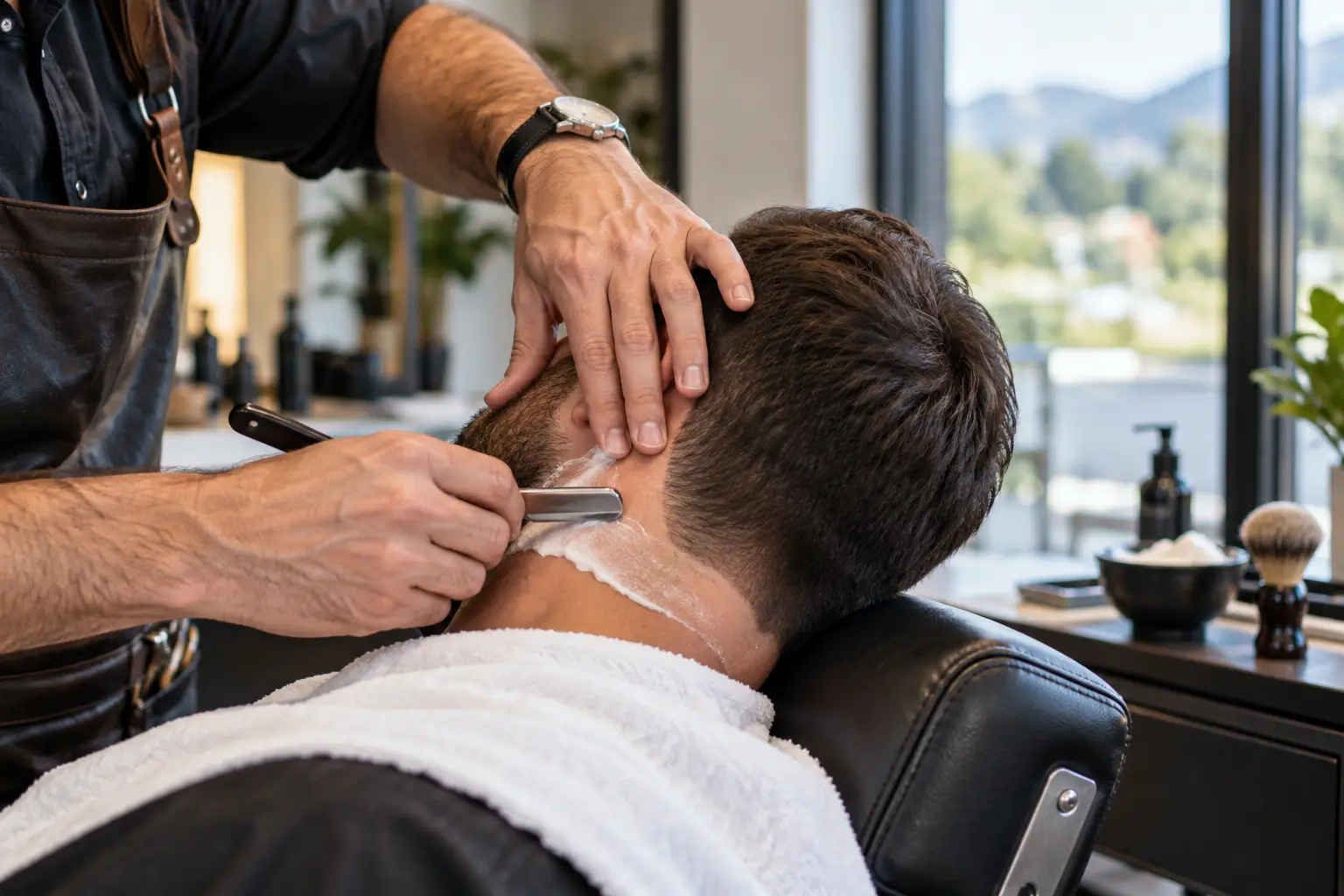
Growth patterns make those edges harder to trim. Coarse stubble often spirals near the throat, and repeatedly cutting it back leaves crooked lines and sore skin. According to dermatology guidance, shaving against uneven growth with cheap multi-blade razors causes chronic folliculitis, or inflamed hair follicles.
Practical check: Keep your throat line no higher than two fingers above your Adam's apple so your chin doesn't look separate from your neck.
During a men's haircut, your stylist shapes the edges around the base of your skull. Getting those lines balanced helps the cut hold its shape, so it still looks neat between appointments.
Mapping Cut Geometry to Your Natural Jaw and Bone Structure
The right cut balances your face shape instead of repeating it. Rounded volume at the sides makes a naturally round face look wider. Height on top, with less bulk at the temples, gives a better balance. Finish that shape with a crisp, squared neckline rather than adding more curves.
Video: GQ explains how to choose a haircut for your face shape.
Selecting the Right Perimeter Foundation
At your haircut consultation, we check forehead width, cheekbone width, jaw angle and chin depth. Those proportions tell us where to leave fullness and where to sharpen an edge. Choose a qualified local stylist who assesses your face before picking up the shears, rather than applying the same shape to every cut.
| Face Shape | Recommended Starting Point | What to Watch |
|---|---|---|
| Round | Taper the sides and add crown texture, with a squared throat line | Rounded sideburns and bulky scissor crops make the cheeks look wider. |
| Square | A classic side part with a soft temple fade and natural cheek line | Sharp, boxed corners can make an already square jaw look too blunt. |
| Oblong | A layered scissor crop with fullness at the sides and a lower neckline | Tall pompadours make a long face look longer. |
| Oval | Flexible styling with balanced layers and a clean neck taper | Heavy forward fringes hide the face's natural balance. |
For a haircut that makes a round face look slimmer, keep the sideburns narrow and finish the neck with a straight razor. Clean edges draw the eye up and down rather than across the cheeks. That contrast gives softer features a more defined outline.
Correcting Asymmetry Across Uneven Stubble and Sideburns
Few men have perfectly even beard or hair growth. Hair on the side you chew with most is often thicker, while the opposite cheek can look sparse. Ignoring that difference leaves the finished cut looking lopsided. Office lighting and professional photographs can make the imbalance especially noticeable.
Here at our lounge, we often correct uneven lines left by rushed clipper work. Crooked sideburns look particularly awkward when they don't account for ear placement. By checking the direction each hair grows, we can remove bulk from thicker areas and give sparse patches a clean outline.
| Growth Situation | Recommended Choice | Avoid |
|---|---|---|
| Patchy cheeks | A lower, natural border defined with a single blade | High cheek lines that draw attention to sparse growth. |
| Two growth swirls at the throat | A soft fade just above the cowlick's center | Blunt, squared clipper lines that let hair flare out within days. |
| Uneven sideburn thickness | Remove bulk with scissors over a comb, then align with a razor | Matching lengths without checking whether both sides look equally full. |
Stylist check: Align sideburn bottoms with the tragus, the small flap in front of the ear canal, rather than the earlobe.
Unsure which haircut suits your face shape? Start by looking at where the sideburns meet your facial hair. Fading that area smoothly into clean skin frames the face and gives the cheekbones more definition.
Integrating Beard Lines with Scissor Work and Tapers
Your haircut and facial hair need to work together. A tight fade beside thick, untrimmed stubble leaves an abrupt change at the cheek. Equally, hard beard lines that look drawn on can clash with a soft, medium-length scissor cut. Neither part should look as though it belongs to a different style.
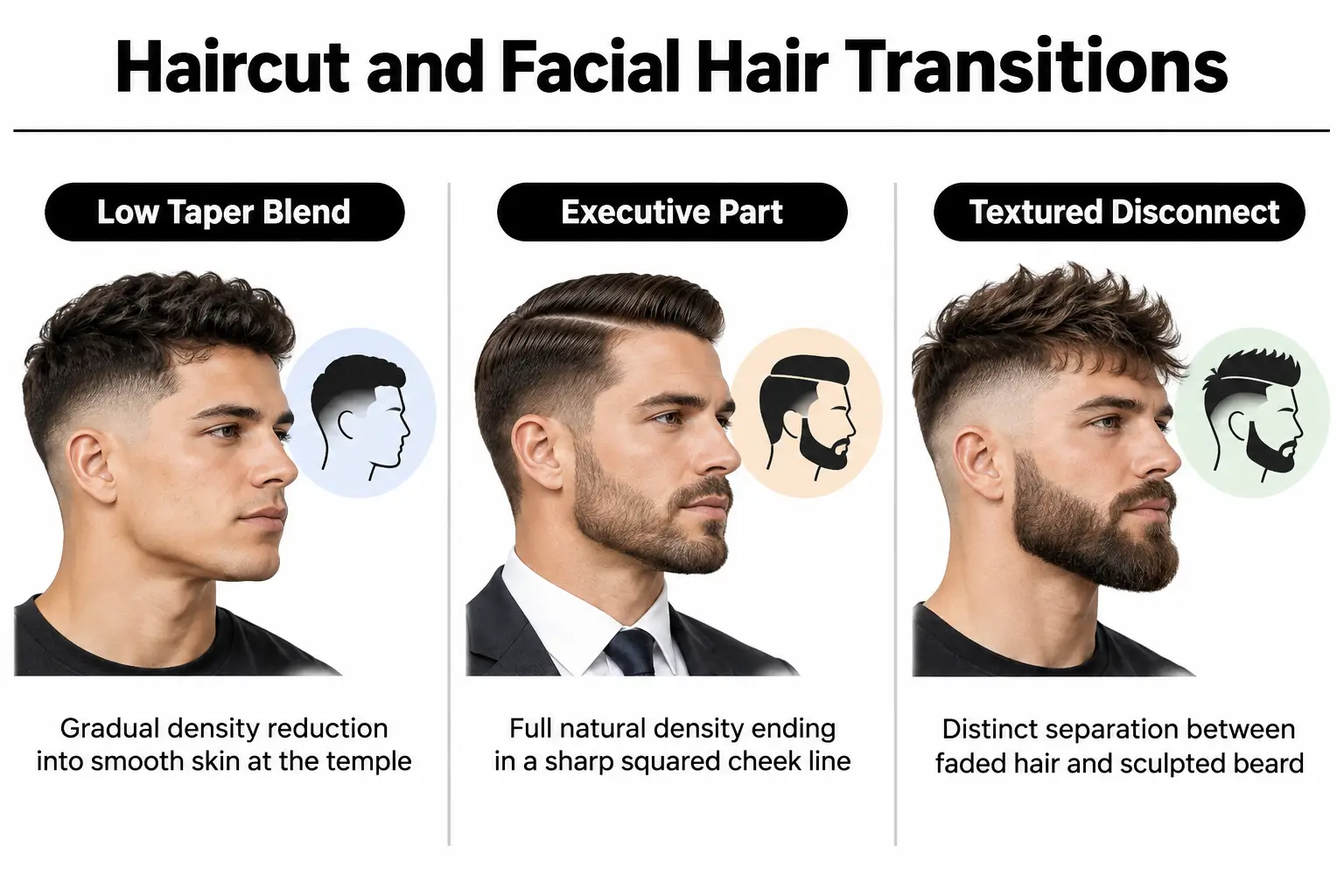
Careful blending connects the two. Following traditional straight razor techniques, we gradually reduce hair thickness through the temples and follow the direction of jawline stubble. For a precise finish, your stylist needs to treat the haircut and beard as parts of the same shape.
| Haircut Style | Beard Transition | What to Test | Visual Result |
|---|---|---|---|
| Low taper fade | A gradual temple blend into stubble | Stubble length at the top of the ear | An even transition down the jawline |
| Classic scissor part | Defined sideburns with natural fullness | Sideburn width along the cheekbone | A neat outline suited to the office |
| Modern textured crop | A separate sideburn or a sharply tapered one | Gap between the temple fade and the top of the beard | Stronger angles for a modern look |
Clients who want a polished look for work often pair their cut with our hot spa shave. Together, these services bring the haircut and facial hair into balance. The shave clears scruffy patches between the two while leaving skin healthy and comfortable.
The Precision Blade and Steam Process That Locks In the Frame
Clean edges without razor burn start with preparing the skin and hair with heat. Our shave follows these steps, from checking your growth pattern to reviewing the finished lines:
- Skin assessment: First, we check the direction of growth and locate swirls. Sensitive patches and hollows along the jaw need particular attention.
- Essential oil barrier: A botanical pre-shave layer softens coarse whiskers and lubricates the skin so the blade can move across it.
- Steamed towel wrap: Warm, damp heat softens the hair's outer layer and opens pores, helping the blade glide without pulling.
- Warm lather application: Thick cream is whipped and worked into the whiskers to hold the hairs upright for shaving.
- Single-blade sculpting: A freshly sanitized blade follows the grain. This defines the edges around the ears and cheekbones, then along the neck.
- Chilled compress and tonic: A cool towel seals the skin barrier, followed by an alcohol-free balm to prevent redness.
- Perimeter styling: A final check with scissors makes sure the new razor lines blend naturally into the rest of your haircut.
Blade safety rule: Every shave should meet California's sanitation standards, with single-use disposable blades for each client.
Prefer to have your treatment at home? Book our shave house call for private service throughout Westlake Village. For recurring bumps after shaving, read our guide to managing razor bumps, which explains how a classic straight razor can help keep your neck smooth.
Evaluating Service Tiers and Grooming Investments
Salon menus don't always make the difference between a basic trim and a full grooming package clear. Men often ask us which is worth booking. How quickly your edges lose their shape is a useful guide. Professional razor work saves time otherwise spent trying to correct those lines during your morning shave.
| Service Level | What to Prioritise | What to Question |
|---|---|---|
| Essential trim ($) | Accurate scissor work and neat curves around the ears | Rushed clipper work pressed against the neck without preparing the skin |
| Tailored cut & finish ($$) | Texture suited to your hair, plus razor-defined edges | Skipping the hot towel before razor touch-ups |
| Signature shave & style lounge ($$$) | A full facial steam treatment and detailed razor work | High prices without botanical skin tonics or proper aftercare |
Compare the styling and shampoo services to find a package that covers both your haircut and facial grooming. Paying a little more for edging with warm lather gives you a defined neckline that keeps its shape for weeks.
Questions Westlake Village Clients Ask About Face Shapes and Shaves
How often should I get razor detailing to keep my haircut looking sharp?
Most men need blade touch-ups every two to three weeks to keep their lines neat. Crown hair grows about half an inch a month, but stubble on the neck and cheeks looks untidy sooner. Regular edge cleanups help the main haircut last longer between visits.
Will a hot shave irritate sensitive neck skin prone to ingrown hairs?
No, professional straight-razor shaving is gentler on delicate skin than multi-blade cartridges. Cartridge blades cut whiskers below the skin's surface, causing painful ingrown hairs. Over steamed skin, a sharp single blade cuts the hair flush without irritating the follicle, the pocket from which the hair grows.
Can changing my neckline make my jawline look stronger?
Yes, a sharp, squared line just above the hyoid, a bone in the upper neck, gives the jaw more visible depth. A rounded neckline or stubble spreading down the throat makes your profile look softer. Careful razor work adds definition in the places that need it.
What makes the steam towel so important prior to blade work?
Steamed towels expand the hair shaft and soften keratin, the tough protein that makes up hair. Softer whiskers offer less resistance, so the razor moves easily without tugging. Without that preparation, shaving pulls at the hair and can irritate skin or leave tiny surface tears.
Refining Your Signature Look at North Ranch Styling Lounge
Before picking up our shears at our styling lounge, we assess your bone structure and the swirls in your hair growth. Your daily routine matters too. Those details help us shape a cut that flatters your features and looks right for work.
Our quiet Westlake Village lounge offers a comfortable setting for an executive scissor cut or sideburn correction. You can also book a classic face shave with steamed towels.
Use this checklist before booking your next grooming appointment:
- Verify perimeter boundaries: Check that your neckline sits comfortably two fingers above your Adam's apple, rather than creeping too high.
- Balance facial proportions: Use the tragus as the reference for sideburn height, not earlobes that may sit unevenly.
- Prep coarse whiskers: Ask for steam before shaving to protect sensitive skin and prevent ingrown hairs.
- Match hair and stubble: Make sure your sideburns blend into the facial hair you plan to keep.
- Select single-blade edging: Choose detailed razor work instead of a quick, blunt clipper finish along the edges.
Review what to expect at the lounge, then contact our Westlake Village stylists to book your cut and shave.