

A regular, tailored beard trim keeps facial hair in balance with your face. The shape needs to work with your bone structure and natural growth patterns, including the cowlicks that won't lie flat.
For most men here in the Conejo Valley, an understated, sculpted jawline with tapered cheeks looks clean without daily razor work. Uneven cheek growth or coarse hair may need a different approach. A receding hairline can also call for a softer blend at the temples.
Home clippers and rushed fifteen-minute chain-shop appointments can leave blunt borders and irritated skin. Before cutting, we look at where the beard carries its weight and how thickly it grows. Skin condition matters too, especially along the neck, where repeated passes can leave you sore.
What's Inside This Guide
- Why Blunt Clipper Finishes Compromise Facial Structure
- Selecting Your Baseline: Freehand Shears Versus Guarded Clippers
- Calibrating Beard Density to Bone Structure and Hairlines
- Fusing Sideburn Transitions with Modern Haircut Lines
- The Execution Protocol: Six Steps to an Intentional Jawline Profile
- Allocating Your Grooming Investment Across Routine Upkeep
- Straight Answers on Westlake Village Facial Hair Maintenance
- Refining Your Profile at North Ranch Styling Lounge
Why Blunt Clipper Finishes Compromise Facial Structure
One mistake we see in Westlake Village is pressing a fixed plastic clipper guard flat against the skin for the whole trim. Hair often changes direction along the neck and lower jaw. Running clippers straight across those changes cuts unevenly and can leave a ragged outline within three days.
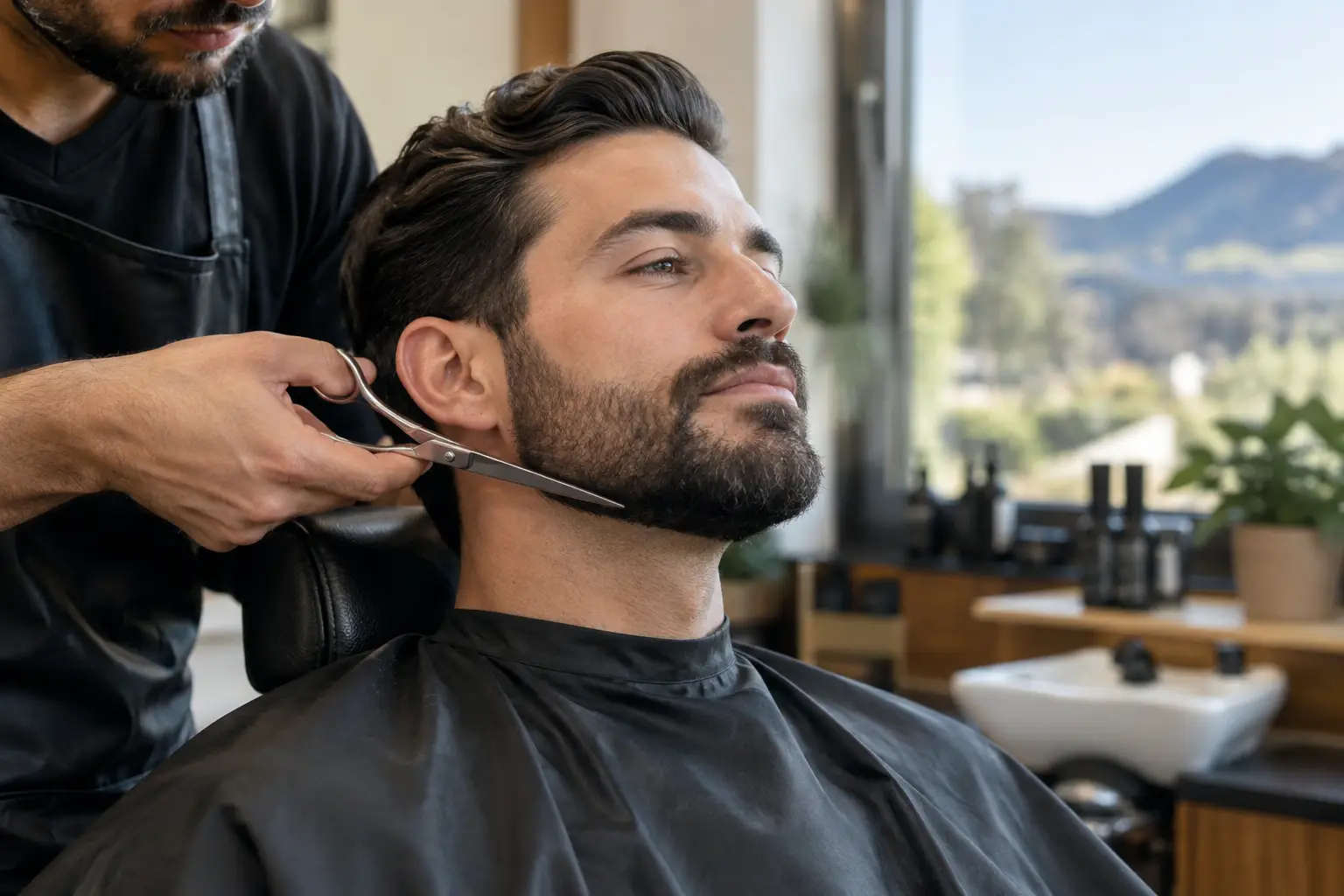
That approach also misses how hair builds up under the chin and at the jaw corners, making the face look wider.
Dry trimming at home or rushed multi-blade shaving can cause ongoing inflammation. According to the American Academy of Dermatology, aggressive shaving friction and blunt cut edges trigger razor bumps and ingrown hairs. The delicate skin along the neck is especially vulnerable. Shaping a beard should protect that skin rather than leave it irritated.
Practical check: Don't set your neckline while looking down into a chest-height mirror. Lowering your chin compresses the neck tissue and puts the line too high.
Borders that creep toward the jawbone quickly erase definition. Our guide to common beard trimming mistakes explains why clear reference points matter before you start cutting.
Selecting Your Baseline: Freehand Shears Versus Guarded Clippers
Start by choosing shears, clippers, or a mix of the two. Guarded clippers work well for evening out uniform stubble. On curly or wiry hair, though, they press the strands down and can leave gaps once the hair springs back. Freehand shears keep natural volume while removing the coarse hairs that push outward.
Evaluating Cutting Methods for Your Texture
Check how your beard lies after a warm shower. Swirling cowlicks along the throat or double crowns at the chin can make clippers pull against the grain. Men seeking careful beard shaping often move from a traditional barber chair to a styling chair for this reason: the cutting method needs to suit the hair.
| Cutting technique | Recommended starting point | What to watch |
|---|---|---|
| Freehand shear shaping | Beards over one inch long; wiry hair with split ends to remove | Needs slow, millimeter-level control and takes longer than a clipper cut |
| Guarded clipper blending | Short office-friendly stubble or even lengths under half an inch | Can catch on swirls and leave blunt, square borders |
| Scissor-over-comb shaping | Medium-density beards that need shaping to fit the face | Comb tension needs care so thinner patches don't lose too much hair |
| Single-blade edge work | Defining upper cheek lines and a clean curve along the lower neck | Follow the grain to avoid folliculitis, inflammation around hair follicles |
Choosing the right method helps keep clean lines from disappearing within forty-eight hours. Careful hand work balances the edges, allowing for individual hairs that grow at slightly different rates each week.
Calibrating Beard Density to Bone Structure and Hairlines
Next, set the borders to suit your face shape and hairline. Growing a large puff under the chin may seem like a way to strengthen a soft jaw. Without tapered cheeks, though, that extra hair makes the face look rounder rather than giving it the definition you want.
Early thinning at the temples becomes more noticeable beside a dark, heavy cheek line because the contrast draws attention upward.
We often help professionals choose beard styles for round faces and softer jaws that create more angular shadows. Gradual changes in length bring out the jaw without leaving a border that looks painted on.
| Face shape or hairline | Recommended choice | Avoid |
|---|---|---|
| Receding temples or thinning crown | Low, tapered cheek lines blending down from a light sideburn | High, dense cheek borders that draw attention to thinning hair |
| Soft jawline with fullness under the chin | A square drop below the chin with a flat vertical shape | Rounding the beard upward along the natural jawbone |
| Angular, prominent chin | A slightly rounded lower edge with softer sides | A pointed goatee that makes the head look too long |
| Patchy cheeks with dense neck growth | Faded stubble on the cheeks with fuller growth at the goatee | Growing stray upper-cheek hairs long in hopes of filling gaps |
Stylist's rule: To give a softer jaw more definition, place the lower border roughly one finger's width above your Adam's apple. This creates a flat shadow rather than a tight chin strap.
Shaving that border too close to the bone leaves an awkward stretch of regrowth. Following these four steps to repair an over-trimmed neckline helps restore the missing lower edge before you reshape the front.
Fusing Sideburn Transitions with Modern Haircut Lines
A beard needs to work with the haircut above it. Even a neat executive cut can look unfinished beside an unmanaged beard, especially where the two meet at the sideburns.
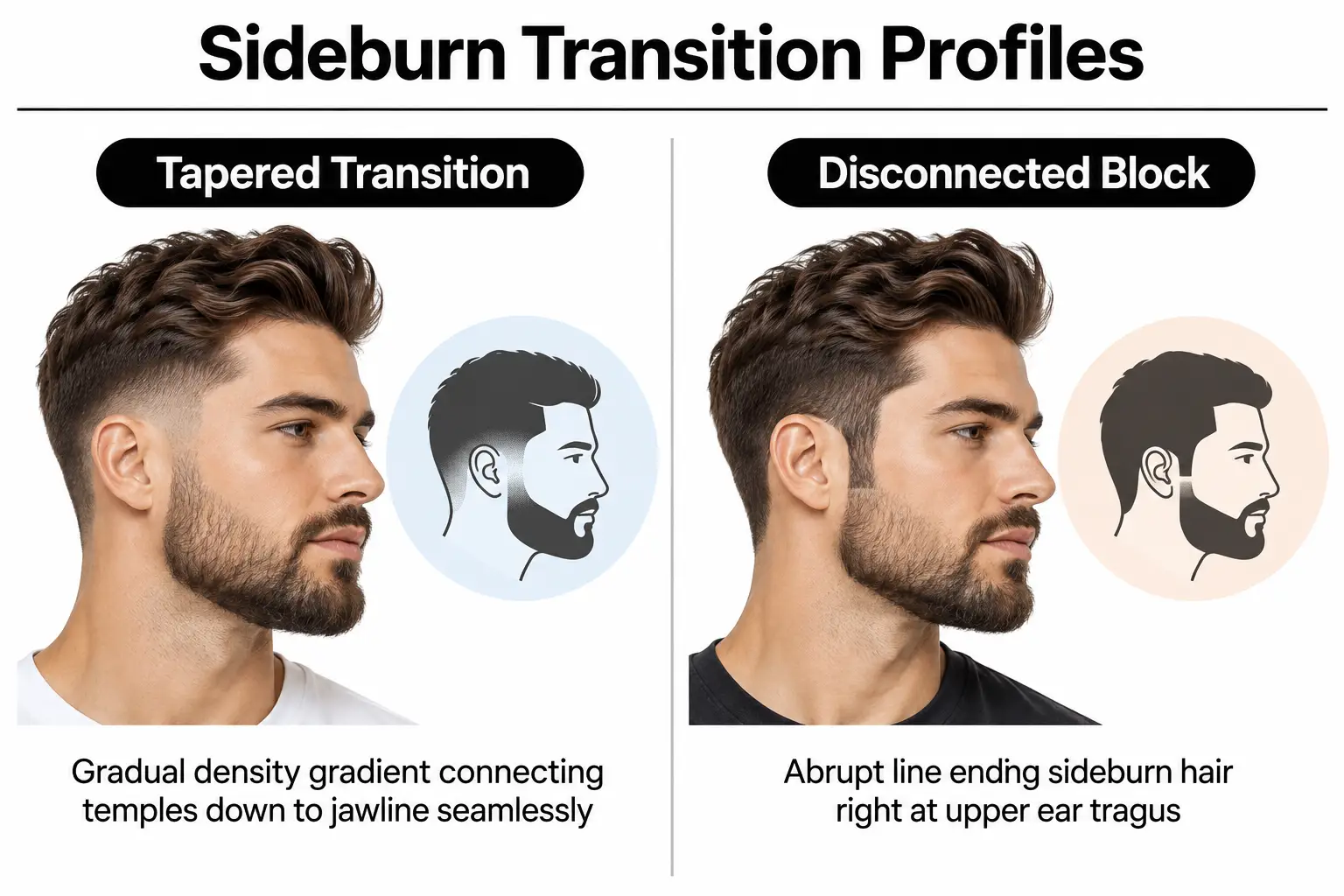
Clipping down to skin at the ear, then leaving a block of beard an inch below, makes the jaw look disconnected.
For men in corporate or client-facing jobs here, blending beard lines into a fade helps the whole cut look tidy enough for work. A gradual taper through the sideburns softens cowlicks around the ears. It also draws the eye down along the jaw rather than stopping at a blunt patch of hair.
| Starting point | How to pair it | What to check | Intended effect |
|---|---|---|---|
| Classic scissor-tapered haircut | A gradual taper from mid-ear down to the jaw corner | Comb forward to check whether sideburn cowlicks bunch up | A balanced professional profile with soft borders |
| Low skin fade | A reverse fade through the upper cheek and sideburn | Check the contrast near the cheekbone in natural sunlight | Clear separation without an abrupt shelf of hair |
| Longer, textured haircut | Keep the natural sideburn connection and remove bulk inside it | Push hair backward with your fingers to check the balance | A relaxed shape without bushy patches at the temples |
| Shaved head or high bald fade | Fade to skin at the tragus, the small flap in front of the ear canal | Check that both temple heights match in a three-way mirror | A strong beard frame that defines the jaw on its own |
This takes an understanding of hair follicle growth angles and where the texture changes. Done well, the blend looks planned and stays neat as the haircut and beard grow out together.
The Execution Protocol: Six Steps to an Intentional Jawline Profile
Working in a set order matters at the salon and during touch-ups at home. Jumping from one part of the face to another makes it easy to lose track of symmetry. Use this sequence to keep the shape balanced as you work:
Video: Scotty Scheller demonstrates beard shaping for a defined jawline.
- Wash and detangle: Use a sulfate-free cleanser to remove oils, then comb downward with a wide-toothed wooden comb to work out hidden knots.
- Remove bulk inside: Use freehand shears or hold the hair with a comb to reduce weight at the lower sides. Keep the outline flush with the cheekbones.
- Set the neckline anchor: Find the spot one inch above your thyroid cartilage, or Adam's apple. Use it as the lowest point at the center.
- Curve toward the ears: Connect that center point to the jaw corners with a gentle upward curve. Keep the skin flat without stretching it.
- Align the cheek lines: Follow a natural straight or slightly curved line from the mustache corner to the sideburn. Remove stray hairs above it.
- Moisturize and smooth: Apply a light botanical oil to soothe the skin's outer layer and help wiry surface hairs lie down.
Before you trim: Don't pull the skin tight while cutting your borders. A straight line can turn wavy when you release the skin.
Coarse or dry beards with split ends may need more than shaping. Pairing the trim with deeper conditioning, such as our beard trim and treatment, softens brittle whiskers that otherwise resist the shape you're trying to keep.
Allocating Your Grooming Investment Across Routine Upkeep
Grooming costs should be easy to plan for. Locally, professional beard shaping costs depend on the work needed: a quick edge cleanup differs from full reshaping with hot towels and conditioning. Knowing the difference helps you avoid paying for more than routine upkeep requires, while leaving room for corrective work when needed.
| Budget level | What to prioritise | What to question |
|---|---|---|
| Routine maintenance ($) | A clean neckline, stray cheek hair removal, and mustache clearance | Rushed walk-in trims with dull, dry blades and no skin prep |
| Full reshaping ($$) | Scissor work to reduce bulk, reset jaw lines, and blend sideburns | Anyone offering to reshape all your facial lines in under ten minutes |
| Full conditioning package ($$$) | Hot towel steam, exfoliation, conditioning oils, and edge work | Heavy chemical softeners or synthetic fragrances that irritate skin |
Spending more can make sense after a home trim goes wrong or before executive headshots. To check current service options and appointment availability, ask our styling team which appointment fits the work your beard needs.
Straight Answers on Westlake Village Facial Hair Maintenance
How often should I get a professional beard trim to keep my jawline sharp?
Most of our clients keep their shape with visits every three to four weeks without sacrificing growth. Faster-growing hair or tightly faded sideburns may need a quick lineup every two weeks. That keeps the edges from getting fuzzy between full trims.
Can a tailored trim camouflage a patchy beard or uneven growth rates?
Yes. Trimming dense areas with scissors over a comb while leaving sparse areas slightly longer makes the beard look more balanced. Blending lighter cheeks into a fuller goatee also helps the thickness look consistent across the jaw.
What should I do if my home trimmer caused an uneven neckline?
Stop cutting and leave the hair untouched for at least ten to fourteen days. Bring the regrowth to a stylist rather than trying to even it out again. We can use the lowest healthy growth points to set a clean line without taking off more length.
Why does my neck get red and inflamed after getting lined up?
Redness after a trim usually comes from harsh dry clipper work or multi-blade razors scraping against the grain. Medical guidance on folliculitis and razor irritation supports calming the follicles with warm, damp towels. Finishing with a single-edge tool also helps greatly reduce that inflammation.
Will trimming split ends actually help my beard grow longer?
Removing dry split ends stops damage from moving up the hair shaft and causing breaks close to the root. Small, regular trims help preserve wiry hairs. The beard can then hold its length and fullness instead of fraying into brittle fuzz.
Refining Your Profile at North Ranch Styling Lounge
At our Westlake Village salon, we give beard shaping the same care as a haircut, without rushing you through the chair. We consider your head and face shape, then check growth patterns against your daily routine. Before a major change at North Ranch Styling Lounge in Westlake Village, California, use this checklist:
- Check natural growth: Leave your beard untouched for at least two weeks before making a major change to its shape.
- Notice the texture: Watch whether your hair curls back toward the skin or tends to stick straight outward.
- Coordinate your haircut: Plan the beard service with your haircut so the blend at the temples works with both.
- Check your skin: Soothe active razor burn with moisturizer before cutting new, sharp borders along irritated areas.
- Choose a useful reference: Look for similar bone structure rather than copying a celebrity whose jawline differs from yours.
Contact our team to schedule your beard shaping appointment.