

A scissor cut keeps its shape for six weeks by following your head's natural curves instead of cutting weight down to the scalp. Pairing it with a beard trim keeps the balance between your temples and jawline as both grow out.
Your hair texture and the direction of your crown growth affect that result. So does the way your sideburns blend into your facial hair.
For men meeting clients or spending their weeks in Westlake Village, California boardrooms, a cut that loses shape after ten days is frustrating. We use tailored scissor work for shape that lasts longer than a buzz-and-fade appointment, without needing constant touch-ups to keep the outline in place.
What's Inside This Guide
- The Hidden Difference Between a 14-Day Fade and a Six-Week Scissor Cut
- Choosing Your Shear Technique: Point Cutting vs. Blunt Texturizing
- Balancing Growth Patterns, Cowlicks, and Early Hairline Shifts
- Integrating Sideburn Tapers with Facial Hair Architecture
- The Structural Steps That Give a Scissor Cut Long Staying Power
- Evaluating Grooming Investment: Frequency vs. Upfront Precision
- Straight Answers on Long-Lasting Men's Scissor Cuts
- Setting Your Six-Week Grooming Calendar at North Ranch Styling Lounge
The Hidden Difference Between a 14-Day Fade and a Six-Week Scissor Cut
Most quick-service shops rely on clippers with plastic guards. These cut strands to the same length across a flat plane, without accounting for how hair stacks as it grows. Within two weeks, cowlicks lift and weight builds behind the ears, leaving a puffy outline.
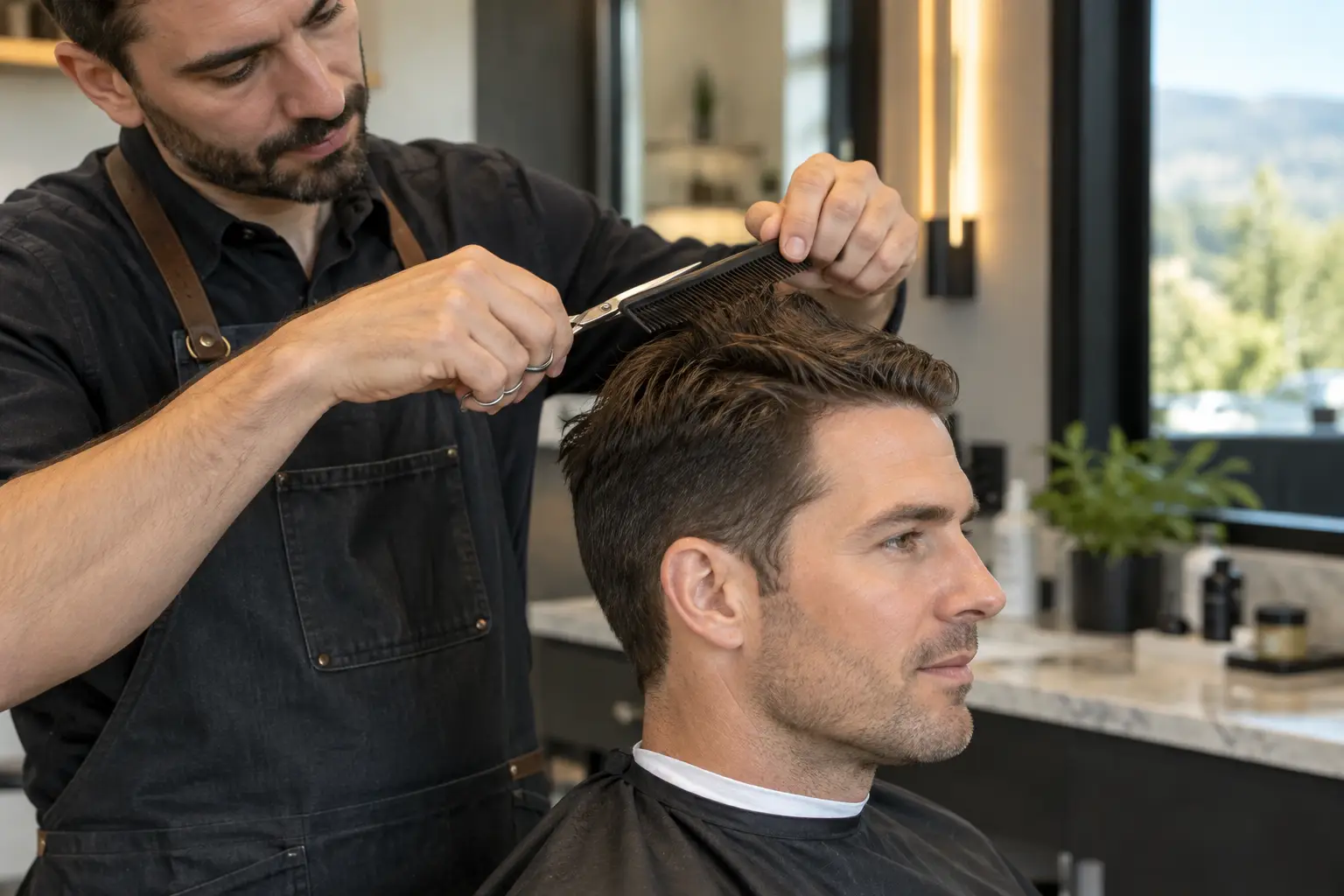
With scissors, we take a different approach. Cutting inner sections at an angle that follows their growth removes bulk while keeping the support the shape needs. Our guide to what goes into a men's style cut explains how that work holds up to everyday styling.
Research on human hair growth puts average scalp growth at roughly half an inch each month. Scissors let us follow the curve of your head. That new half-inch then extends the cut's existing outline instead of pushing it out of shape.
Stylist's rule: A clipper cut looks best on day one, while a tailored scissor cut settles into its best shape between days seven and forty-two.
Choosing Your Shear Technique: Point Cutting vs. Blunt Texturizing
During a men's style cut, the way we angle the scissors affects how your ends settle over time. Blunt cutting goes straight across, making crisp edges but sometimes leaving too much weight inside. Point cutting angles the blades into the hair, leaving soft tips that move past each other rather than bunching together.
Selecting the Right Cutting Method for Your Hair Density
Before booking, ask how your stylist plans to remove bulk beneath the surface of your cut. Thinning shears have notched teeth that can tear coarse strands when used too aggressively. Sliding scissors along the hair and point cutting protect the cuticle, its outer layer, while creating a shape that's easy to style.
| Cutting approach | Recommended starting point | What to watch |
|---|---|---|
| Point cutting to remove inner weight | Wavy hair, or dense and coarse hair that needs movement | Cutting too much from top layers leaves stringy ends |
| Club cutting for blunt outer edges | Fine hair that needs fullness at the ends | Rigid edges quickly show where cowlicks separate |
| Scissor-over-comb cutting for gradual length changes | Tapering sideburns and the nape for mature professionals | Needs a steady hand to avoid uneven steps or gouges |
| Slide cutting along the hair | Longer fringes and classic swept side parts | Dull scissors pull and damage the hair shaft |
Balancing Growth Patterns, Cowlicks, and Early Hairline Shifts
Double crowns and strong front cowlicks need more than a standard haircut pattern. Receding temples do, too. Clippers cut through those growth directions, leaving short tufts that stick out once styling cream wears off. A stylist who tailors the cut to you can check your natural swirl with your hair both wet and dry.
Proper tension, or how firmly hair is held, matters during cutting. Extra weight over a spiral crown lets gravity hold it down. To make a round face look slimmer, we can build height along the top while keeping the upper sides close to the head.
| Head shape & hair pattern | Recommended choice | Avoid |
|---|---|---|
| Strong crown cowlick | Gradual changes in length that follow the natural swirl | Clipping short across the swirl |
| Receding temples | Soft changes in length blending into a textured top | Hard side parts with sharply cut lines |
| Round face with a soft jaw | Square layers at the crown with less volume at the sides | Rounded mushroom shapes or a blunt fringe |
| Uneven thickness at the crown | Point cutting inside the cut to spread weight evenly | Heavy use of thinning shears over sparse areas |
Practical check: Don't let a stylist buzz down a cowlick to hide it. Weight is what keeps a stubborn swirl flat.
Integrating Sideburn Tapers with Facial Hair Architecture
Even a carefully cut hairstyle looks wrong if it clashes with your beard. Sideburns that meet unkempt facial hair without a gradual blend make the jaw look fuller and less defined. Blending down into the cheek line connects the haircut to the beard instead of leaving a visible break.
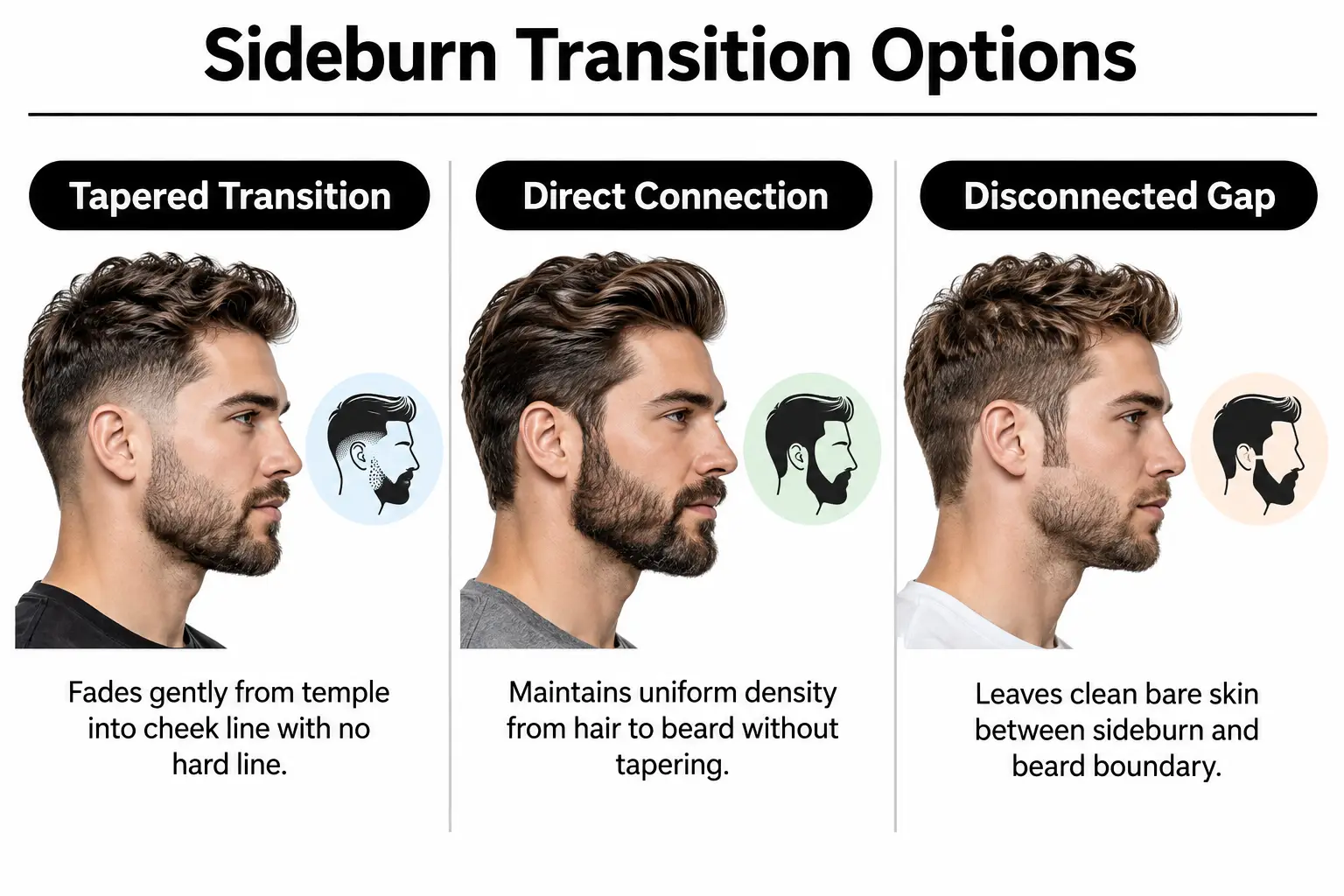
Carving the line too high beneath the chin is one of the beard trimming mistakes that weaken your jawline. Planning the beard shaping alongside your haircut keeps the cheek and neck edges suited to your bone structure. The weight of your mustache needs to fit that balance, too.
Our guide to beard styles for round faces and soft jaws shows how vertical beard lines work with balanced scissor cutting on top.
| Starting point | What to pair it with | What to try | Intended effect |
|---|---|---|---|
| Medium scissor crop | Neatly shaped office-ready stubble | Taper sideburns at the tragus, the flap by the ear opening | A clearly defined jawline |
| Classic executive side part | Full beard shaped to your face | Gradually shorten hair with scissors into the cheek line | A balanced look for work without extra bulk |
| Natural flow with texture | Stubble with a soft, natural neckline | Low taper above the ear line | A relaxed coastal look that still feels groomed |
The Structural Steps That Give a Scissor Cut Long Staying Power
Keeping a haircut in shape through week six takes careful work at each stage, starting with the consultation. Before you book, you can talk with our Westlake Village salon about your hair texture and how you usually style it at home.
Video: The ‘Old Money’ Haircut – Timeless Style, All Scissors | Men's Hair Tutorial (The One Minute Barber)
These are the steps our stylists use to keep the shape intact as your hair grows:
- Consultation: We check growth patterns wet and dry, including crown swirls, and assess hair thickness against your facial bone structure.
- Horseshoe sectioning: Separating the crown from the temples lets us place the cut's weight line where it naturally suits your profile.
- Gradual scissor cutting: Holding the sides over a comb gives us control as we increase length toward the top.
- Removing inner bulk: Point cutting takes weight out of dense sections while keeping the hair's surface length in place.
- Blending facial hair: A detailed line cleanup or dedicated beard trim connects the sideburns naturally to the hair along your jawline.
- Checking the balance: Reviewing the dry cut in natural light lets us check movement and remove any remaining pockets of weight.
Before you leave: Check that your neckline tapers rather than ending in a straight razor line. A blocked edge looks untidy after just seven days of stubble growth.
Evaluating Grooming Investment: Frequency vs. Upfront Precision
Quick walk-in cuts can seem cheaper until you count how often you need them. Hair that loses shape in two weeks sends you back to the chair twice as often to stay tidy. A tailored scissor cut takes more skill and time upfront, but noticeably reduces your visits over the year.
Scheduling a beard trim and treatment alongside your cut helps protect the skin beneath facial hair from dryness and ingrown hairs while keeping the cheek edges neat.
| Service level | What to prioritise | What to question |
|---|---|---|
| Standard quick trim ($) | Speed and a low starting cost for simple short buzz cuts | Heavy clipper work that puffs out after 10 to 14 days |
| Executive scissor cut ($$) | Scissor blending and weight placed to suit your crown's growth pattern | Thinning shears used over cowlicks or thin patches |
| Cut & facial grooming package ($$$) | Full scissor work with hot towel beard shaping and skin conditioning | Facial hair treated as a rushed extra |
Paying more for careful scissor work makes sense if your appearance affects your work. Fewer appointments save hours each month, and your hair stays presentable between visits.
Straight Answers on Long-Lasting Men's Scissor Cuts
Can a scissor cut really hold its shape for six full weeks?
Yes. Cutting at the hair's natural angles lets strands move past each other as they grow, rather than piling into a blunt edge. Clippers treat the head as a flat surface, which makes the grow-out uneven. Scissors let us follow its individual curves and keep the shape balanced.
How do I stop my cowlick from sticking up as my hair grows?
Ask your stylist to leave length and weight directly over the swirl instead of cutting it down with a short clipper guard. That length gives the hair enough weight to lie flat on its own. It also helps the cowlick stay down as the cut grows over the following weeks.
What should I do if my neckline looks unkempt between haircuts?
Choose a softly tapered neckline rather than a hard, squared-off edge. Hair that gradually shortens to skin level hides early stubble better than a sharp line, which shows regrowth after only five days. For a mistake made while trimming at home, follow our guide to correcting an over-trimmed beard neckline.
How should sideburns be blended into a modern beard?
Sideburns should gradually shorten from the top of the tragus, the small flap beside the ear opening. They should then blend into the beard's cheek line without a hard boundary. Read about blending beard lines into fades to see how those gradual changes in length give your profile more definition.
Does thin or receding hair benefit from scissor cutting?
Scissors let us leave weight where it helps cover visible scalp, giving better coverage than an aggressive buzz cut. Point cutting softens the edges around receding temples. That avoids the harsh lines of separation that clippers often leave in finer hair.
Setting Your Six-Week Grooming Calendar at North Ranch Styling Lounge
At our salon, North Ranch Styling Lounge, we tailor executive haircuts to our Westlake Village clients. Each appointment accounts for your head shape and facial features, along with your routine, so the cut stays clean through day thirty. Keep these points in mind before booking:
- Check that your stylist mainly uses hand shears, rather than relying on clipper guards for the whole cut.
- Show your stylist any double crowns or cowlicks, and point out difficult part lines before cutting starts.
- Request a soft, tapered neckline instead of a hard square edge so the regrowth looks less obvious.
- Make sure your sideburns blend gradually into your facial hair without an abrupt change in length.
- Book a careful beard trim with your haircut if you keep stubble or other facial hair.
Visit the salon or contact us to book your cut and plan your six-week grooming schedule.